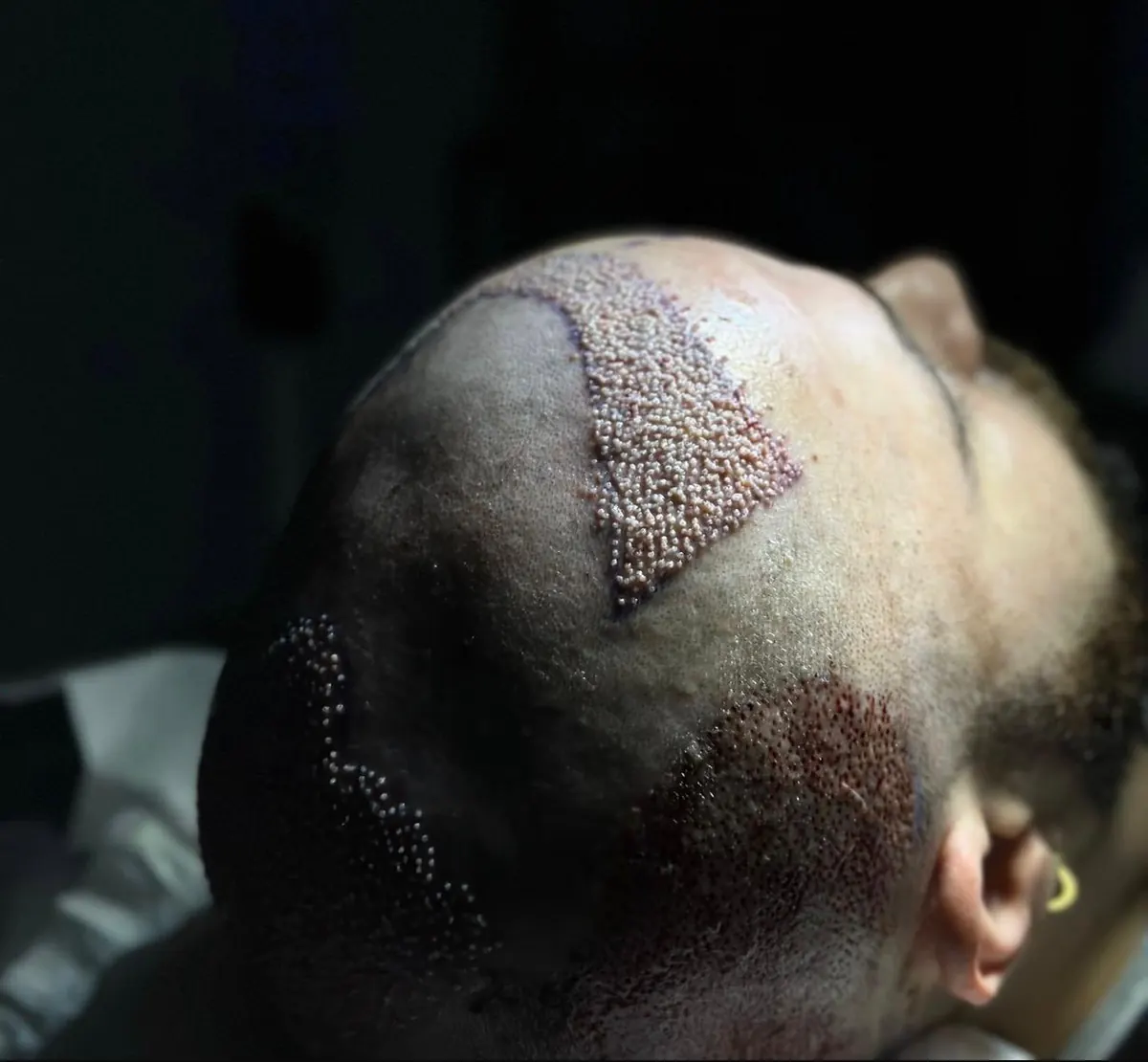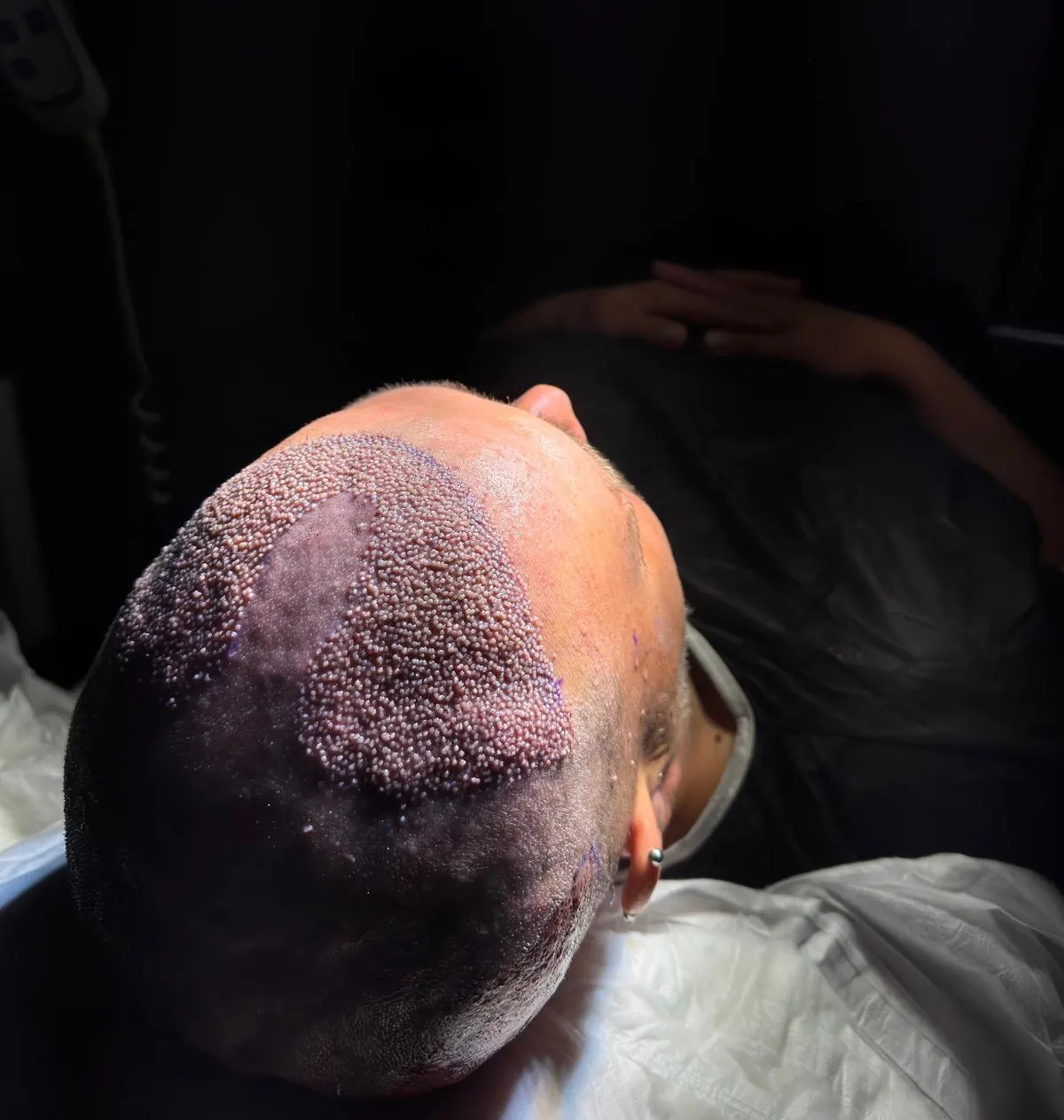
How the hair graft calculator works
Choose the picture that looks most like your hair loss today. The hair graft calculator then shows a typical graft range for that stage. The stages come from the Norwood scale, the system doctors use to describe male pattern hair loss.
The result is an estimate. It does not take into account your hair thickness, your donor area or how your hair loss may progress. Use it to understand the size of the work, then send photos for a personal plan.
How many grafts do I need? Norwood stages 2 to 7
The ranges below are general industry ranges for the area usually treated at each stage. Your own number can be lower or higher.
| Norwood stage | What it looks like | Typical grafts |
|---|---|---|
| Norwood 2 | Slight recession at the temples | 500–1,500 |
| Norwood 3 | Deeper temple recession, the hairline forms an M or U shape | 1,500–2,500 |
| Norwood 4 | Further frontal loss plus thinning at the crown, with a band of hair between them | 2,500–3,500 |
| Norwood 5 | The band between front and crown becomes thin | 3,000–4,500 |
| Norwood 6 | Front and crown join into one bald area | 4,000–5,500 |
| Norwood 7 | Only a horseshoe of hair remains at the sides and back | 5,000+ (limited by donor capacity) |
Norwood 2 and 3: early hair loss
At these stages the work is usually focused on the hairline and temples. Hairline design matters more than graft count. Young patients need extra care, because their hair loss may still progress.
Norwood 4 and 5: front and crown
Many patients at these stages need work on the front and the crown. Doctors often give priority to the front, since it frames the face. The crown may be treated in the same session or later, depending on the donor area.
Norwood 6 and 7: advanced hair loss
The area to cover can be larger than the donor area can fill at full density. The plan aims for good coverage where it matters most. Some patients need two sessions. Learn more in our guide how many grafts do I need.
What donor capacity means
The donor area is the back and sides of the scalp. Hair here is usually resistant to pattern hair loss, so grafts taken from it keep growing after they are moved. Your donor area typically supplies around 4,000 to 6,000 grafts over a lifetime.
Donor capacity depends on:
- Density: how many follicles grow per square centimetre.
- Size: how large the safe donor zone is.
- Hair thickness: thicker hair gives more coverage per graft.
- Hairs per graft: grafts with more hairs give more volume.
Grafts taken from the donor area do not grow back. If too many are taken at once, the back of the head can look thin. A careful plan keeps some grafts in reserve in case your hair loss progresses.
Grafts vs hairs: what is the difference?
A graft is a tiny unit of skin that contains a natural group of one to four hairs. On average, one graft holds about 2 to 2.5 hairs. So 2,000 grafts usually means roughly 4,000 to 5,000 hairs.
This matters when you compare offers. Some quotes count hairs, which makes the number look much higher. Always ask whether a figure refers to grafts or hairs.
Graft type also affects the design. Single-hair grafts go at the very front of the hairline for a soft, natural edge. Grafts with two to four hairs go behind them to build density.
Why the doctor's graft number may differ
The calculator only knows which stage you picked. A doctor looks at much more:
- Your donor density and how many grafts it can safely give.
- Your hair thickness, colour and curl. Thick or curly hair covers more scalp per graft.
- The contrast between your hair and skin colour.
- Your age and family history, which affect future hair loss.
- How dense you want the result to be and where.
- Whether a hair transplant is right for you now. Some patients are better served by medical therapy, such as finasteride or minoxidil, which needs a doctor's prescription.
Dr. Alakaya decides the graft count on medical grounds. Packages have a fixed price with no per-graft billing, so there is no reason to raise the number. You can read how pricing works on the hair transplant cost in Turkey page.
Get your personal graft estimate
Take clear photos of the front, top, crown and back of your head in good light. Send them through the contact page. Dr. Alakaya will review your hair loss and donor area, then suggest a technique and a graft range. He may recommend sapphire FUE hair transplant or DHI hair transplant depending on your case. To see what different graft numbers can achieve, visit the hair transplant before and after gallery.
Frequently asked questions
How many grafts do I need for a hairline?
Many patients with early temple recession need around 1,000 to 2,000 grafts for the hairline. Your exact number depends on the area, your hair type and your donor density.
How many hairs are in one graft?
A graft holds one to four hairs, about 2 to 2.5 hairs on average. So 2,000 grafts usually means about 4,000 to 5,000 hairs.
What is the maximum number of grafts in one session?
It depends on your donor area and the doctor's judgement. Taking too many at once can thin the donor area, so large cases are sometimes split into two sessions.
How accurate is a hair graft calculator?
It gives a typical range for your Norwood stage. The final number comes from a doctor's assessment of your donor area, hair type and goals.
Can I get a hair transplant with Norwood 7?
Some patients can, if their donor area is strong. The aim is good coverage of key areas, since the donor area may not cover the whole scalp at full density.