What is a graft?
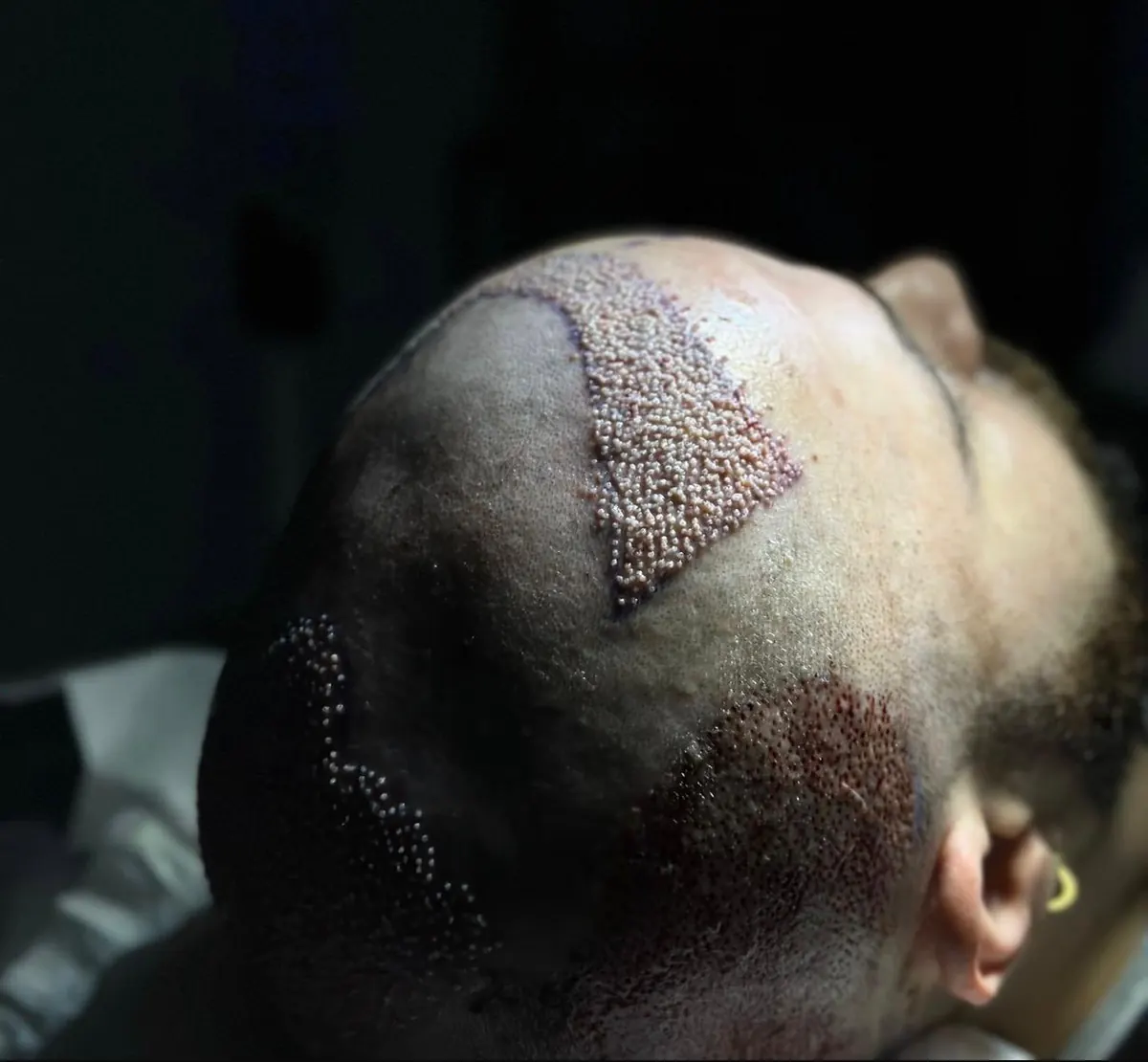
A graft is a follicular unit. This is a natural group of one to four hairs that grow together from the scalp. In a hair transplant, the surgeon moves these units one by one from the donor area to the thinning or bald area.
One graft is not one hair. On average, a graft holds about two hairs, and figures of 2 to 2.5 are often quoted. This differs from person to person. So 3,000 grafts usually means roughly 6,000 to 7,500 hairs. When you compare plans, always ask whether a number refers to grafts or hairs.
How many grafts do I need? Rough ranges by Norwood stage
Doctors often describe male hair loss with the Norwood scale, from stage 1 (no loss) to stage 7 (only a horseshoe of hair at the back and sides). The ranges below are rough, commonly quoted ranges for the area usually treated at each stage. Published figures vary a lot between sources, and two men at the same stage can need very different numbers. They are not a quote. Your own number can only be set by the doctor after examining your scalp and donor area.
| Hair loss pattern | Rough graft range |
|---|---|
| Norwood 2: slight recession at the temples | 500–1,500 |
| Norwood 3: deeper temple recession, M- or U-shaped hairline | 1,500–2,500 |
| Norwood 4: further loss at the front plus crown thinning, with a band of hair between them | 2,500–3,500 |
| Norwood 5: the band between front and crown becomes thin | 3,000–4,500 |
| Norwood 6: front and crown join into one bald area | 4,000–5,500, often over two sessions |
| Norwood 7: only a horseshoe of hair remains at the sides and back | 5,000+, limited by donor capacity |
A Norwood 3 vertex pattern, with temple recession plus crown thinning, usually falls between the Norwood 3 and 4 ranges, depending on how much of the crown is treated. At Norwood 6 and 7 the upper figures can be more than many donor areas can give. These plans aim for good coverage where it matters most, not full density everywhere.
Want a rough range for your own pattern? Try our hair graft calculator, then share your photos for a personal plan.
How doctors calculate how many grafts you need
The basic sum is simple: the area to cover, in square centimetres, multiplied by the planned density in grafts per square centimetre. The skill lies in choosing both numbers well.
A healthy scalp holds very roughly 65–100 follicular units per square centimetre. A transplant does not copy that. Surgeons typically place about 20–40 grafts per square centimetre, with the highest density at the front. Surgical guides note that about half of the original density is usually enough for hair to look full.
A simple example: a frontal zone of about 50 square centimetres, planned at 35 grafts per square centimetre, needs around 1,750 grafts. The same sum answers a common question. At 30–40 grafts per square centimetre, 2,000 grafts cover roughly 50–65 square centimetres. That is often enough for a hairline and the front third, but not for the front, top and crown together.
In a fully bald area, one operation restores only part of the original density. The UK charity Alopecia UK puts it at about 30%. This is why some patients choose a second session later to add density.
Factors that change how many grafts you need
Two people with the same Norwood stage can need very different graft numbers. These are the main reasons.
Size of the area
A large head with a wide bald area needs more grafts than a small one at the same stage. The surgeon measures the area in square centimetres and plans density per area.
Desired density
A higher target density needs more grafts for the same area. A careful surgeon balances density at the front with coverage further back, so the donor area is not used up in one place.
Hair characteristics
Thick, wavy or curly hair covers more scalp per graft. Fine, straight hair needs more grafts for the same look. Low contrast between hair and skin colour also makes thinning less visible. A higher number of hairs per graft helps too.
Hairline position
A lower, flatter hairline uses many more grafts than a slightly higher, age-appropriate one. A conservative hairline also leaves grafts in reserve for later.
Your donor area sets the limit
Grafts come from the donor area at the back and sides of the head. These follicles are usually resistant to the hormone DHT, which drives male pattern hair loss. That is why transplanted hair tends to stay.
The donor area is finite. Most people have roughly 4,000–6,000 grafts available over a lifetime. Some have more and some have less. Taking too many in one go can leave the donor area visibly thin, and that cannot be undone.
A careful surgeon checks donor density with magnification before giving a graft number. If a plan promises a very high number without a donor check, ask how that number was reached. The ISHRS also warns patients about promises of huge or unlimited graft numbers, because donor hair is finite. Our checklist on how to choose a hair transplant surgeon lists other questions to ask.
Plan for future hair loss
Hair loss often continues after a transplant. The transplanted hair usually stays, but native hair around it can keep thinning. A 25-year-old with a Norwood 3 pattern may later reach Norwood 5.
A good plan takes this into account. It places grafts so the result still looks natural if more hair is lost. It also keeps donor grafts in reserve for a possible second session. Medical therapy can help slow further loss. Finasteride is a prescription medicine, and minoxidil should also be used on a doctor's advice. Neither is right for everyone, and a doctor should supervise their use.
Check the cause of hair loss first
Not every kind of hair loss suits a transplant. Sudden diffuse shedding, patchy loss such as alopecia areata, or thinning linked to thyroid problems or low iron needs a diagnosis before anyone counts grafts. A medical history, a scalp examination and, when needed, blood tests come first.
How many grafts per session?
In one day, many sessions move somewhere between 1,500 and 4,500 grafts. The right number depends on donor quality and the area to cover. The technique matters too. Sapphire FUE is often used for higher graft numbers. DHI is often used for smaller areas and hairline work. Our sapphire FUE vs DHI decision guide explains which suits which case.
Very large sessions bring more time outside the body for each graft and more stress on the donor area. When a case needs more than one safe session can give, splitting the work over two operations is often the wiser plan.
Grafts for the crown, beard, eyebrows and women
Crown
The crown, also called the vertex, uses more grafts than people expect. Hair there grows in a spiral, and the area can keep expanding over time. Crown results also take longer, up to 18 months.
Beard and eyebrows
Smaller procedures need fewer grafts. A full beard transplant usually uses 2,000–4,000 grafts, and smaller areas such as a moustache or goatee need fewer. An eyebrow transplant usually uses a few hundred grafts.
How many grafts do women need?
Hair loss in women is often diffuse. It thins hair across the top of the head instead of forming a receding hairline or bald crown. A transplant is usually only an option when the donor area is stable and dense enough, and when the cause of the hair loss has been checked. Graft numbers for women are often between 1,000 and 3,000, used to add density to the parting or to lower a high hairline. A blood test and scalp examination usually come first. Read more on our female hair transplant page.
Does the number of grafts change the price?
Some clinics charge per graft. This can push the graft number up, because every extra graft adds to the bill. Dr. Harun Alakaya works with a fixed-price package with no per-graft billing. The number of grafts is then set by your scalp and donor area, not by the price. See what a package includes on our hair transplant cost in Turkey page.
How to get an accurate graft estimate
Common mistakes with graft numbers
- Planning only for today's loss: areas that may thin later are left out, and a new gap appears behind the transplant.
- Mixing up grafts and hairs: 6,000 hairs and 6,000 grafts are very different amounts.
- Using the whole donor area at once: this can remove the option of a second session.
- Skipping the in-person check: donor density can only be measured accurately up close.
Steps to a reliable estimate
Online ranges are a starting point. To get a real estimate:
- Take clear photos of the front, top, crown, both sides and the back, in good light with dry hair.
- Tell the doctor your age, how long you have been losing hair and any treatments you have used.
- Ask for the planned graft number, the target area and the planned hairline in writing.
- Ask how much donor reserve will remain after the operation.
Dr. Harun Alakaya plans each case himself and confirms the final graft number after he examines your scalp and donor area in person. You can send your photos for a free analysis and a first estimate.
Frequently asked questions
Is 3,000 grafts a lot?
3,000 grafts is a medium to large session. It falls within the ranges often quoted for a Norwood 3 to 4 pattern, though the right number depends on your area, hair type and donor supply.
How many hairs are in 4,000 grafts?
A graft holds about two hairs on average, often quoted as 2 to 2.5, so 4,000 grafts usually means roughly 8,000–10,000 hairs. Your own hairs-per-graft ratio can be higher or lower.
Can I get 5,000 grafts in one session?
Some patients with a very strong donor area can, but many cannot do so safely. Splitting large cases over two sessions can protect the donor area and graft quality.
Will I need a second hair transplant?
Some patients do, especially if they are young or their hair loss continues. A plan that saves donor grafts keeps that option open.
How many grafts do I need for the hairline only?
A hairline-only plan often uses about 1,000–2,000 grafts, depending on how far the temples have receded and how low the line is set. A conservative, age-appropriate line usually needs fewer.
Is 6,000 grafts a lot?
Yes. 6,000 grafts is close to or above the lifetime donor supply of many people, so it is usually split over two sessions, when it is possible at all.
Sources
- Alopecia UK – Surgery: Hair Transplants
- StatPearls (NCBI Bookshelf) – Hair Transplantation (Goldin, Zito, Raggio)
- Journal of Cutaneous and Aesthetic Surgery – Logic of Hair Transplantation (Venkataram & Mysore, 2018)
- American Academy of Dermatology – Hair loss: Diagnosis and treatment
- ISHRS – Hair Transplant Black Market Red Flags

Our articles explain hair transplant topics in plain language. They are general information and do not replace a consultation with a doctor.
About the doctor