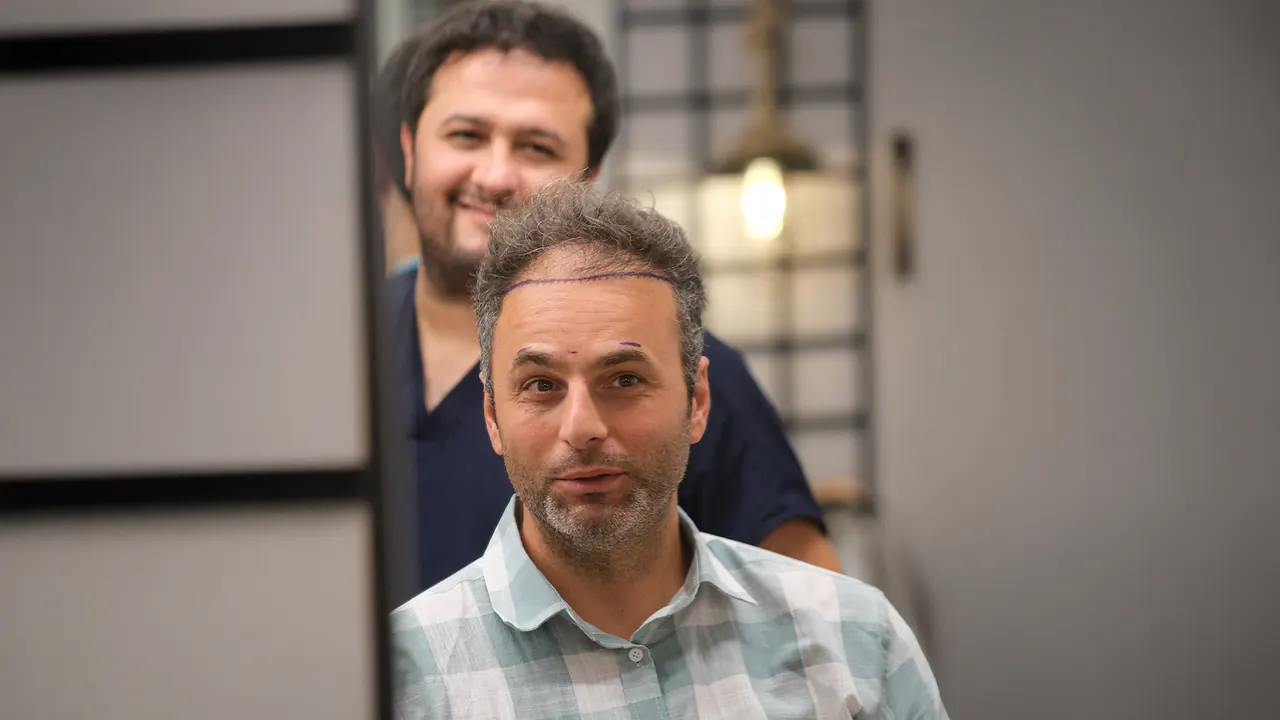
Before the operation: hair transplant candidacy and planning
Am I a good candidate for a hair transplant?
Good candidates usually have pattern hair loss that has started to stabilise and a healthy donor area at the back and sides of the head. Your general health also matters. A doctor needs to see clear photos or examine you to confirm.
What is the best age for a hair transplant?
There is no fixed age. Many surgeons prefer to wait until the mid-20s, when the pattern of loss is clearer. Younger patients can still be treated, but the plan must allow for further loss and keep grafts in reserve.
How many grafts do I need?
It depends on the size of the thinning area, your hair type and your donor supply. A receding hairline may need 1,500–2,500 grafts, while advanced loss can need 4,000 or more. Our hair graft calculator gives a rough range, and our guide on how many grafts you need explains the factors.
Which technique is right for me: sapphire FUE or DHI?
Sapphire FUE usually suits larger areas and higher graft numbers. DHI usually suits the hairline, smaller areas and unshaven work. Many plans combine both. Read our sapphire FUE vs DHI comparison for details.
Do I need to stop any medication before surgery?
Some medicines and supplements affect bleeding, such as blood thinners, aspirin and some vitamins. Tell the doctor everything you take. Never stop a prescribed medicine without asking the doctor who prescribed it.
Should I stop smoking and alcohol before a hair transplant?
Yes, if you can. Smoking reduces blood flow to the scalp and can slow healing. Most clinics ask you to avoid alcohol for several days and smoking for at least one to two weeks before and after surgery.
Operation day: what happens during a hair transplant
How long does a hair transplant take?
Most operations take 6–8 hours, including planning, breaks and implantation. Larger sessions or unshaven work can take longer.
Is a hair transplant painful?
The procedure is done under local anaesthesia. Most patients feel the anaesthetic injections at the start and then only pressure or mild discomfort. Many patients rest, watch films or sleep during the operation.
Will I be awake during the operation?
Yes. Hair transplants are done under local anaesthesia, so you stay awake. You can talk, take breaks, eat lunch and use the bathroom.
Do I have to shave my head?
Not always. Sapphire FUE usually needs the recipient area shaved. With an unshaven hair transplant, often done with DHI, only small parts of the donor area are trimmed and can be hidden under longer hair.
Who performs the operation?
Dr. Harun Alakaya plans each case himself, designs the hairline by hand and opens the channels himself. Implantation is done by a certified team under his supervision. He limits the number of patients per day.
Will there be scars?
FUE does not leave a linear scar. It leaves tiny dot scars in the donor area that are usually hidden under short hair. With very short clipper settings, some people can see them up close.
After the operation: hair transplant recovery
When can I go back to work after a hair transplant?
Most people return to desk work in 3–5 days. Jobs with heavy physical work, dust or heat usually need 1–2 weeks. See the full hair transplant recovery timeline.
When can I wash my hair?
The first wash is usually done at the clinic one or two days after surgery. You then wash gently at home each day with the products and method you are shown, usually for about two weeks.
Is swelling normal after a hair transplant?
Yes. Mild swelling of the forehead and around the eyes is common between days 2 and 5. It usually settles on its own within a week. Sleeping with your head raised helps.
When do the scabs fall off?
Small scabs form around the grafts and usually fall off by days 10–14 with gentle washing. Do not pick or scratch them.
What is shock loss, and is it normal?
Shock loss is when transplanted hairs shed, usually between 2 and 8 weeks after surgery. It is normal. The follicles stay in the scalp and start growing new hair in the following months.
When can I exercise, swim or wear a hat?
Light walking is fine straight away. Most doctors advise waiting about 2 weeks for the gym and about 4 weeks for swimming, saunas and contact sports. A loose hat that does not press on the grafts is usually fine in the first days; ask your clinic before wearing a tighter cap.
Hair transplant price and travel to Istanbul
How much does a hair transplant cost in Turkey?
The price depends on the technique, the area and the package. Dr. Harun Alakaya's packages start from the figure shown on the hair transplant cost in Turkey page, and the final price is confirmed after you share your photos.
Is the price per graft?
No. Packages have a fixed price with no per-graft billing. The graft number is set by your scalp and donor area, not by the bill.
What is included in the package?
Packages include hotel accommodation, VIP transfers, blood tests, medication, an aftercare kit, the first wash and follow-up at 3, 6, 9 and 12 months.
How many days do I need to stay in Istanbul?
Most patients stay about 3 days: arrival and consultation, the operation day, and the first wash before flying home.
When can I fly home after a hair transplant?
Most patients fly home the day after the first wash, usually 2–3 days after surgery. Take care not to bump your head on luggage racks and keep the recipient area clean.
Why do people travel to Turkey for a hair transplant?
Istanbul has many experienced hair surgeons and teams. Costs are often lower than in the UK, EU or US, and all-inclusive packages make planning simpler. Choose by surgeon, not by price. Our checklist on how to choose a hair transplant surgeon can help.
Hair transplant results
When will I see results?
New hair usually starts to grow at 3–4 months. Most patients see a clear change at 6–8 months. The final result is usually seen at around 12 months, and up to 18 months for the crown.
Is a hair transplant permanent?
Transplanted hair comes from the donor area, which is usually resistant to pattern hair loss, so it tends to last. Native hair around it can still thin over time.
Will the result look natural?
It can. A natural look depends on hairline design, the angle and direction of each graft and the choice of single-hair grafts at the front. See real cases in our hair transplant before and after gallery.
What percentage of grafts survive?
Graft survival depends on careful extraction, how long grafts stay outside the body, how they are handled and your own healing. Most grafts usually survive when the work is careful, but no clinic can honestly guarantee an exact percentage.
Will I need a second hair transplant?
Some patients do, especially when they are young or their hair loss continues. A good first plan keeps donor grafts in reserve so a second session stays possible.
Do I need medication after a hair transplant?
Not always. Medical therapy such as finasteride or minoxidil can help protect native hair. These need a doctor's prescription and are not right for everyone. PRP hair treatment is another option some patients use alongside surgery.
Frequently asked questions
Is a hair transplant painful?
The procedure is done under local anaesthesia. Most patients feel the anaesthetic injections at the start and then only pressure or mild discomfort.
How much does a hair transplant cost in Turkey?
The price depends on the technique, the area and the package. Packages start from the figure on the cost page, with a fixed price and no per-graft billing.
How many grafts do I need?
It depends on your thinning area, hair type and donor supply. A receding hairline may need 1,500–2,500 grafts, while advanced loss can need 4,000 or more.
When will I see hair transplant results?
New hair usually starts to grow at 3–4 months. The final result is usually seen at around 12 months, and up to 18 months for the crown.
Is a hair transplant permanent?
Transplanted hair comes from the donor area, which is usually resistant to pattern hair loss, so it tends to last. Native hair around it can still thin over time.
When can I go back to work after a hair transplant?
Most people return to desk work in 3–5 days. Physical jobs usually need 1–2 weeks.
What is shock loss after a hair transplant?
Shock loss is when transplanted hairs shed, usually between 2 and 8 weeks after surgery. It is normal, and new hair usually grows in the following months.
Do I have to shave my head for a hair transplant?
Not always. Sapphire FUE usually needs the recipient area shaved, while an unshaven hair transplant, often with DHI, only trims small parts of the donor area.
How long does a hair transplant take?
Most operations take 6–8 hours, including planning, breaks and implantation. Larger or unshaven sessions can take longer.
How many days do I need to stay in Istanbul for a hair transplant?
Most patients stay about 3 days: arrival and consultation, the operation day, and the first wash before flying home.