Hair transplant aftercare in the first 10 days at a glance
The first 10 days after a hair transplant are about two things: protecting the new grafts and letting the skin heal. Most patients feel well within a few days. The grafts are still fragile in the first week and settle firmly into the scalp over roughly the first 10 days. This guide covers that short window. For the full year, see our hair transplant recovery timeline.
Here, day 0 is the day of your operation and day 1 is the day after. Protocols differ between surgeons, so always follow the written instructions you receive.
| Day | What usually happens | What you do |
|---|---|---|
| Day 0 | Tight or numb scalp, mild pain as the anaesthetic wears off, some oozing at the donor area | Rest, keep your head raised, take only the prescribed medication |
| Day 1 | Check-up, dressing often removed, mild soreness | Avoid bending forward, do not touch the grafts |
| Day 2 | Swelling may start on the forehead, first wash usually done by now | Learn the washing method at the clinic |
| Day 3 | Swelling often most visible, can move towards the eyes | Gentle daily wash, head raised at night |
| Day 4 | Swelling starts to fade, small crusts around each graft | Keep washing as shown; many patients fly home around now |
| Day 5 | Crusts are firm, itching may begin | Do not scratch or pick |
| Day 6 | You feel close to normal, scalp still pink | Many return to desk work between days 3 and 7 |
| Day 7 | Swelling usually gone | Washing can become slightly firmer if your team agrees |
| Day 8 | Crusts soften and start to come off, with small hairs | Gentle circular movements with your fingertips |
| Day 9 | Most crusts loose or gone | Keep the same routine |
| Day 10 | Few crusts left, most grafts well anchored | Stay gentle until about day 14 |
Day 0 and day 1: rest, head raised, hands off
On the day of the operation, the local anaesthetic wears off over a few hours. Your scalp may feel tight, numb or sore. Mild pain is common and is usually controlled with the medication your doctor prescribes. The donor area at the back of the head may ooze a little on the first night, which is why it is often covered with a dressing.
How to sleep after a hair transplant
Sleep on your back with your head raised. Medical guidance suggests raising the head end of the bed by about 15 to 30 degrees for the first week to limit swelling. Two pillows or a travel pillow work well and keep the recipient area off the pillowcase. Do not sleep on your front or side in the first week.
Do not touch, scratch or rub the grafts. Avoid bending forward for long periods, for example to tie shoelaces or pick things up from the floor. On day 1 most clinics see you for a check, and any dressing on the donor area is usually removed in the first days. Some protocols also use a saline (salt water) spray to keep the recipient area moist. Use it only if your team gives it to you.
Days 2 to 4: the first wash and swelling after a hair transplant
The first wash
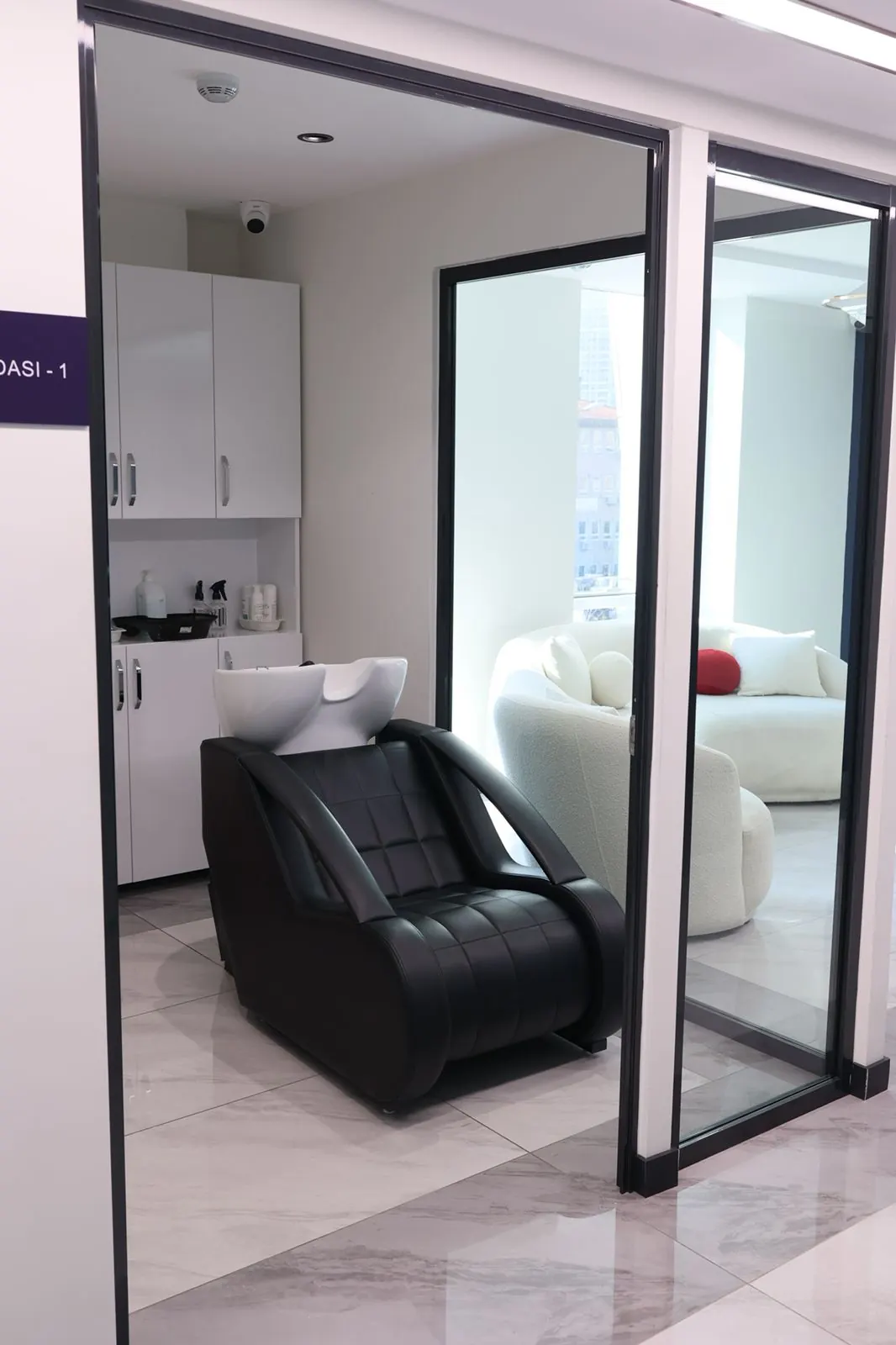
The timing of the first wash differs between surgeons, from about 24 hours to several days after surgery. In Dr. Harun Alakaya's package, the first wash is done at the clinic, usually a day or two after the operation. The team shows you the method so you can repeat it at home. Our guide on how to wash your hair after a hair transplant explains each step.
When does swelling go down?
Swelling usually appears around day 2 or 3. It starts on the forehead and can move down to the eyelids and cheeks before it fades. It can look dramatic, but it is common and usually harmless. For most patients it settles between day 5 and day 7.
To keep it down, sleep with your head raised and avoid bending over. Some surgeons also recommend a cold pack on the forehead. Never put ice on the grafts themselves.
Days 3 and 4
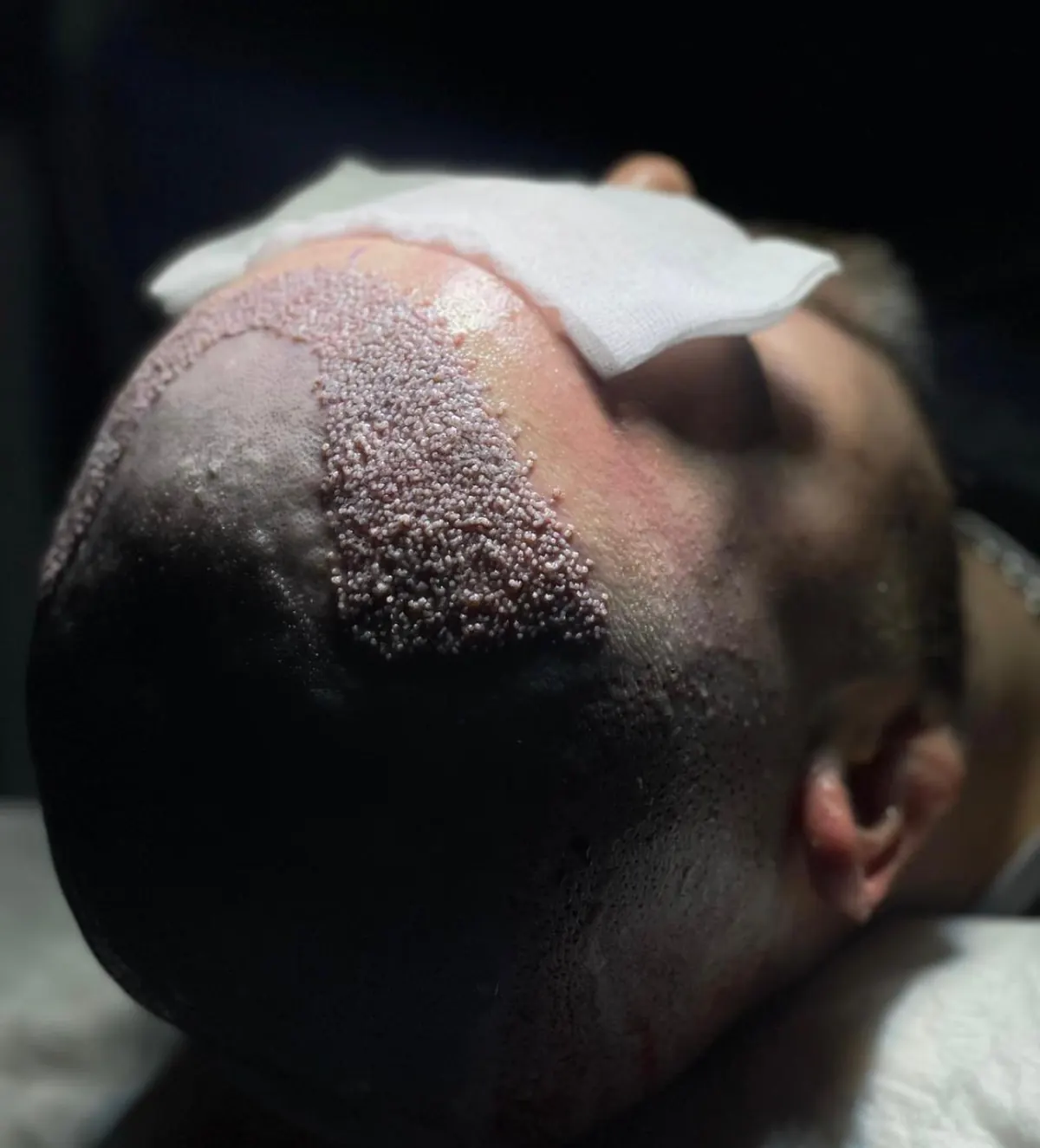
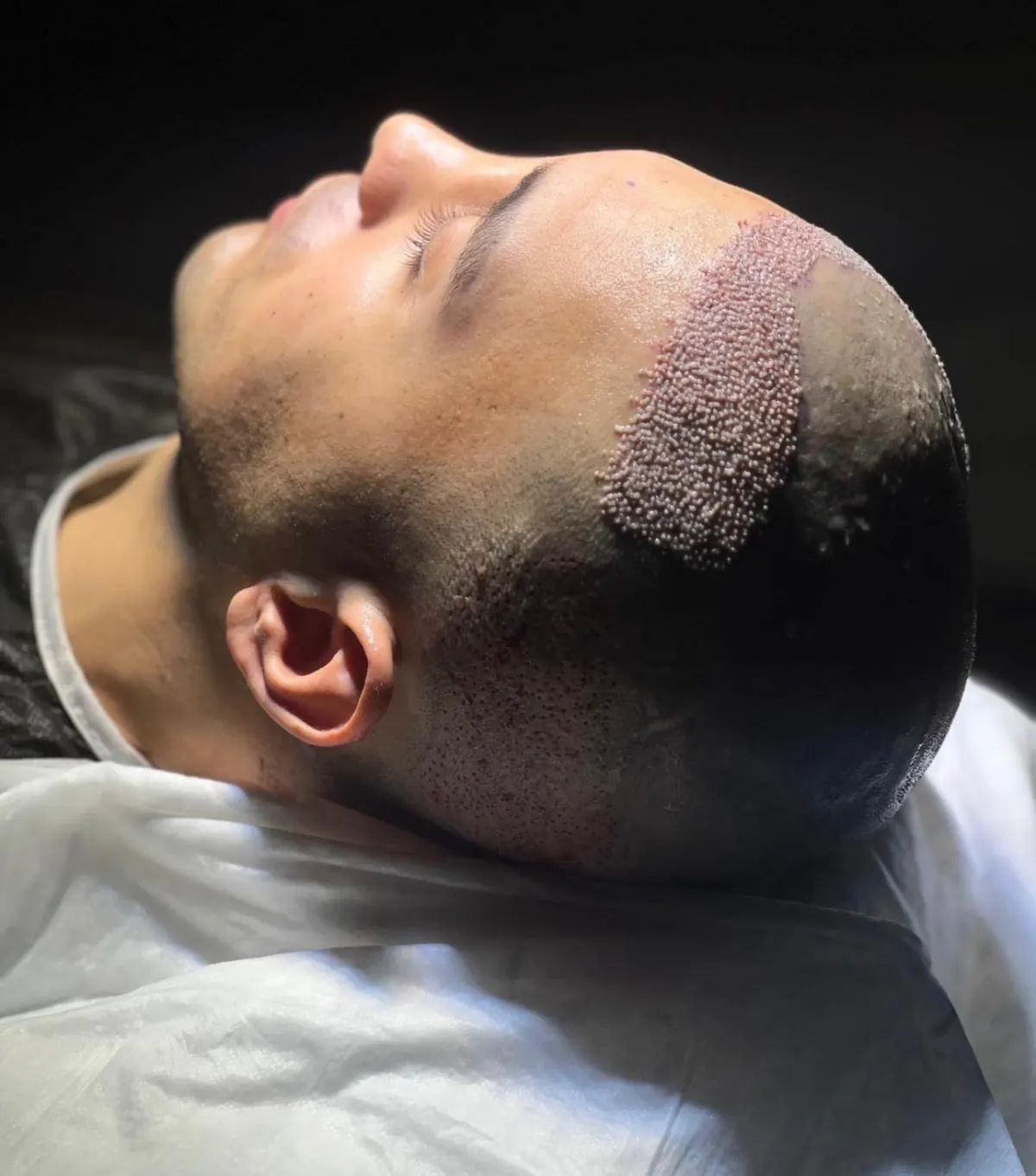
Wash as often as your team advises, using only the products in your aftercare kit. Tiny crusts form around each graft. They are dried blood and fluid that protect the healing skin. Leave them alone.
Days 5 to 7: scabs, itching and going back to work
By day 5 the crusts are firm and the scalp may start to itch. Itching is common while the skin heals. Drying and crusting skin is one of the main causes. Do not scratch. Regular washing and the products in your kit usually help. If itching keeps you awake, ask your doctor what you can use.
The donor area heals faster than the recipient area. Its small crusts often loosen first, and some surgeons allow gentle rubbing of the donor area from around day 5 to 7.
When can I go back to work after a hair transplant?
Many people return to desk work between day 3 and day 7. The NHS says you may need one to two weeks off, which suits people with physical jobs or those who prefer to wait until the scabs are gone. With an unshaven hair transplant, the existing hair can cover the area, so some patients go back sooner.
By day 7 the swelling has usually gone. If your team agrees, washing can become slightly firmer from now on. Keep the recipient area away from the pillow for a few more nights.
Days 8 to 10: when scabs fall off after a hair transplant
Between days 7 and 10 the crusts soften with washing. Gentle circular movements with the fingertips, never the nails, help them come away. In most patients the crusts are gone within one to two weeks.
Short hairs often come off with the scabs. This is normal. What you see is the hair shaft. The follicle, the living root, usually stays in the skin and grows a new hair later.
By about day 10, most grafts are well anchored. You still need to be careful: the NHS advises being very careful with the transplanted hair for the first two weeks. The skin often stays pink for a few more weeks, especially on fair skin.
What not to do in the first 10 days after a hair transplant
| Activity | Advice for the first 10 days |
|---|---|
| Touching, scratching, picking scabs | Avoid completely |
| Sleeping on your front or side | Avoid in the first week; sleep on your back with your head raised |
| Bending forward, heavy lifting | Avoid for at least the first week |
| Gym, running, heavy sweating | Wait; light walks are fine. Gym usually after 2–4 weeks |
| Tight caps, beanies, helmets | Avoid; a loose hat is usually fine after the first few days |
| Direct sun on the scalp | Avoid; use shade or a loose hat |
| Swimming, sauna, steam room | Avoid; usually allowed after about 4 weeks |
| Smoking and alcohol | Avoid; both can slow healing. Ask your doctor when to restart |
| Hair dye, gel, spray, wax | Wait until the skin has fully healed; dye usually after 4–6 weeks |
| Strong shower jets on the grafts | Use a cup or a low-pressure flow on the recipient area |
These are common rules. Your own timeline can be shorter or longer depending on your technique, graft number and how your skin heals.
Medication and products in the first week
Your doctor decides which medication you need. After a hair transplant this often includes a painkiller and, in some cases, an antibiotic or a medicine to reduce swelling. Not every surgeon prescribes antibiotics routinely. Take exactly what you are given, for as long as you are told, and do not add other medicines or supplements without asking. Tell your doctor about any regular medication, especially blood thinners.
Use only the lotion, foam or shampoo from your aftercare kit in the first 10 days. If you used finasteride or minoxidil before surgery, ask your doctor when to restart. Both are prescription treatments that need a doctor's supervision, and topical products such as minoxidil are not applied to fresh wounds unless your doctor says so.
Flying home after a hair transplant in Istanbul
Most international patients fly home a few days after surgery, often around day 3 to 5. Flying is usually fine at this stage. A little planning makes the trip easier:
- Keep your medication, aftercare kit and written instructions in your hand luggage.
- Bring a travel pillow so the recipient area does not touch the headrest.
- Wear a loose hat or hood if you want privacy, and put it on and take it off carefully.
- Ask someone else to lift heavy bags into the overhead locker.
- If travel day clashes with a wash, ask the clinic how to adjust the timing.
- Save the clinic's contact details so you can send photos from home.
The package includes hotel, VIP transfers and the first wash, so your first days in Istanbul are planned around aftercare. See what is included on the hair transplant cost in Turkey page.
When to call your doctor in the first 10 days
Some redness, swelling, tightness and itching are normal. Contact the clinic quickly if you notice any of these:
- Fever or feeling unwell.
- Redness that spreads or darkens instead of fading.
- Pus, many painful spots or a bad smell.
- Pain that gets worse after the first few days.
- Bleeding that does not stop with light pressure from clean gauze.
- Swelling that keeps increasing after day 5.
- A dark patch in the recipient area, or thick crusts that stay well beyond two weeks.
These problems are uncommon, and early contact makes them easier to treat. Send clear photos with your message so the team can assess the area quickly.
After day 10: what comes next
Once the scabs are gone, most patients look much as they did before surgery, with some pinkness. Between weeks 2 and 8, most transplanted hairs fall out. This is called shock loss after a hair transplant, and it is expected. New hair usually starts to grow at 3 to 4 months. Most patients see the final result at around 12 months, and the crown can take up to 18 months.
If you are planning your procedure and want to know what your own first 10 days would look like, send photos of your scalp through the contact page for a free analysis. More answers are on our hair transplant FAQ page.
Frequently asked questions
Can I touch my head 10 days after a hair transplant?
Gentle touching during washing is usually fine by day 10, because most grafts are anchored. Avoid scratching, hard rubbing and picking any remaining scabs until your doctor says the area has healed.
Can a graft fall out in the first few days?
It can if the area is rubbed, scratched or knocked in the first days. If you see a small bleeding point, press gently with clean gauze and contact your clinic. A short hair coming away with a scab after day 7 is normal.
When can I wear a hat after a hair transplant?
A loose hat that does not press on the grafts is usually fine after the first few days. Avoid tight caps, beanies and helmets for the first weeks, and put any hat on and off carefully.
Is it normal to feel almost no pain?
Yes. Many patients feel only tightness or numbness. The amount of discomfort varies between people and does not show how well the grafts are doing.
Can I shower in the first 10 days?
You can shower your body, but keep strong water jets off the recipient area. Rinse the scalp with a cup or a low-pressure flow, as shown at your first wash.
When does numbness go away after a hair transplant?
Numbness in the donor or recipient area usually fades over a few weeks. In some people it takes a few months. Tell your doctor if it gets worse instead of better.
Sources
- NHS – Hair transplant
- StatPearls (NCBI Bookshelf) – Hair Transplantation
- Garg AK, Garg S. Complications of Hair Transplant Procedures: Causes and Management. Indian J Plast Surg, 2021 (PMC)
- ISHRS – Guide to FUE Hair Transplant: Benefits, Process & Recovery
- American Society of Plastic Surgeons – Hair Transplant Recovery
Our articles explain hair transplant topics in plain language. They are general information and do not replace a consultation with a doctor.
About the doctor