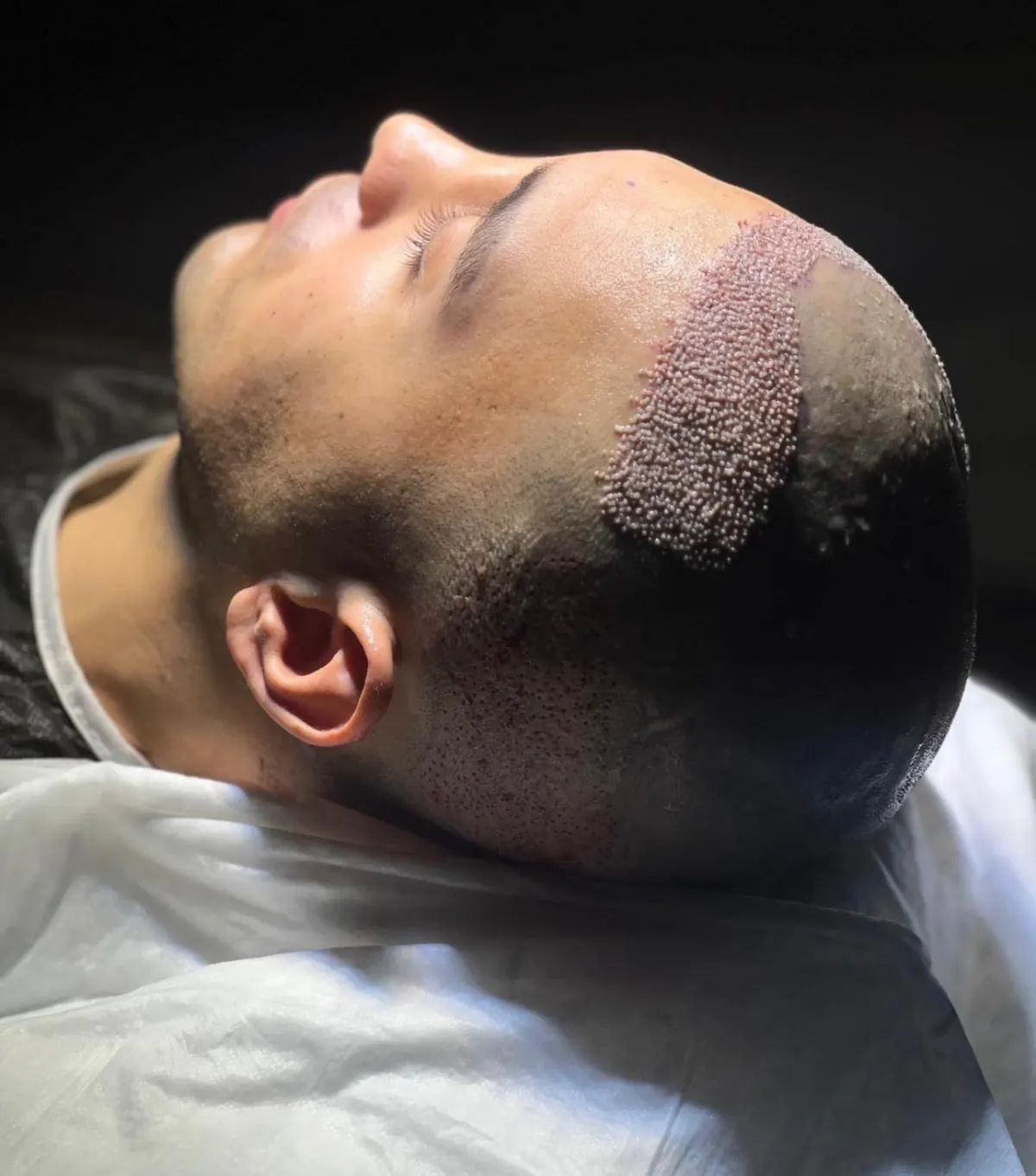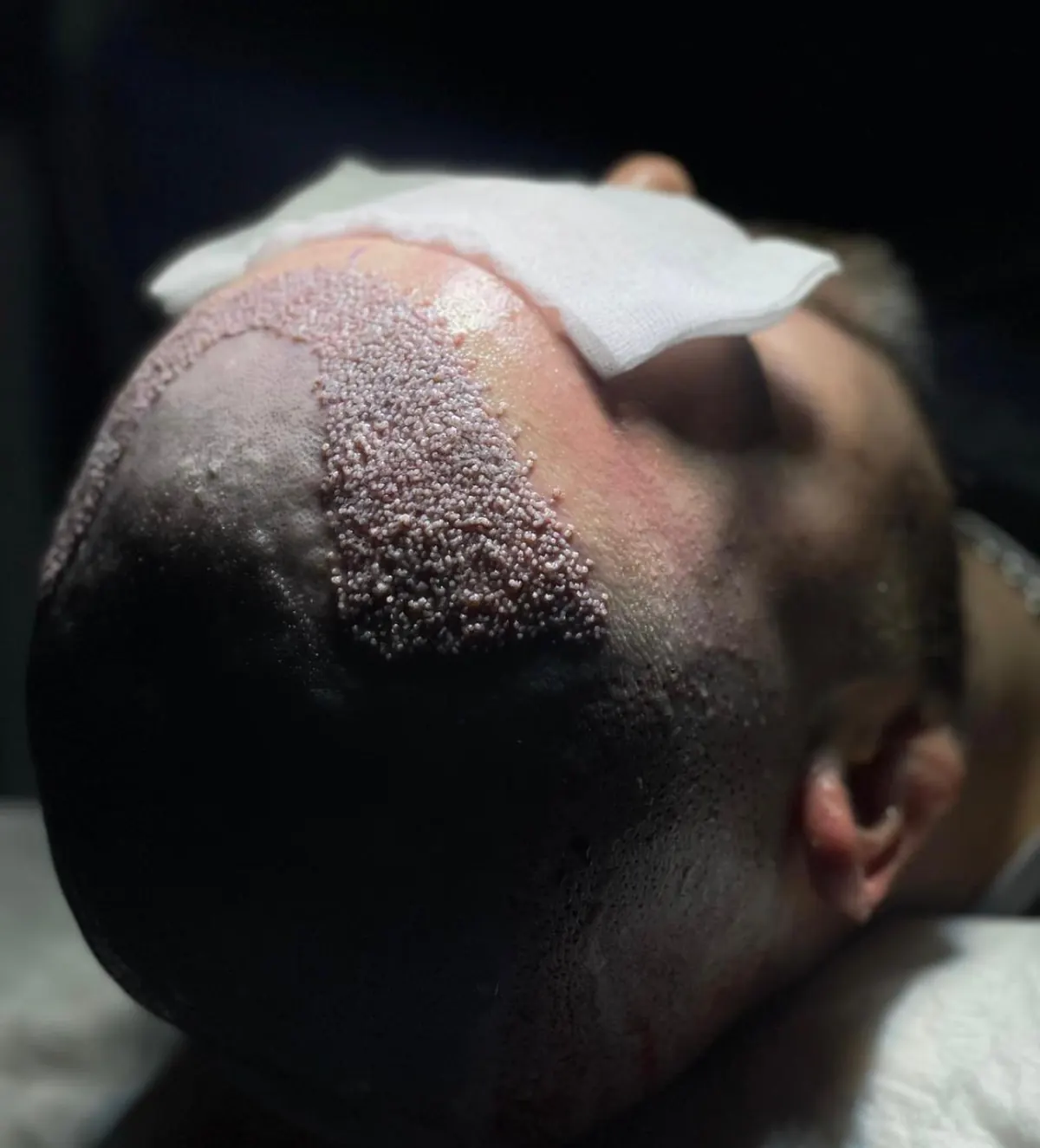
Shock loss after a hair transplant: the short answer
Shock loss is a temporary shedding of hair after a hair transplant. It usually starts between week 2 and week 8. The hair shafts fall out, but the follicles (the roots that make hair) stay alive under the skin. They rest for a few weeks and then start a new growth cycle.
The American Academy of Dermatology describes this shedding as normal. It also notes that by the third month the hair may look thinner than before surgery. New hair usually appears from month 3 to 4. Most patients see a clear change between months 6 and 9. The final result usually takes around 12 months, and the crown can take up to 18 months. You can see the full picture on our hair transplant recovery timeline.
Shock loss does not mean the operation has failed. It is how hair follicles normally respond to being moved.
Two kinds of shedding after a hair transplant
People use the words "shock loss" for two different things. It helps to know which one you are seeing.
| Type | What sheds | Usual timing | What happens next |
|---|---|---|---|
| Shedding of transplanted hair | The short hairs placed in the recipient area | Weeks 2–8 | Roots stay in place; new hair from month 3–4 |
| Shock loss of native hair | Your own existing hair around the transplanted area | Often from week 3–4 | Healthy hair usually regrows within 3–4 months |
| Donor area shedding | Hair around the extraction sites at the back of the head | Weeks after surgery; rare | Usually regrows over the following months |
Shedding of transplanted hair happens in almost every patient. ISHRS describes it plainly: the hair grafts fall out, but the root is still there.
Marked loss of native hair is much less common. In one published series of almost 2,900 patients from a single surgeon, visible loss of native hair was recorded in three patients in the recipient area and in one in the donor area. Milder thinning is harder to measure, so reported rates differ between studies.
Shock loss timeline: week by week and month by month
| Time after surgery | What you may see |
|---|---|
| Days 1–14 | Small scabs around the grafts; short hairs still visible; grafts anchor by around day 10–14 |
| Weeks 2–8 | Most transplanted hairs shed; some native hair nearby may shed too |
| Months 1–3 | The area can look as it did before surgery, or thinner. Many call this the "ugly duckling" phase |
| Months 3–4 | First fine new hairs appear |
| Months 6–9 | Clear change; hairs grow longer and thicker |
| Month 12 | Final result for most patients |
| Months 12–18 | The crown and denser areas can keep improving |
Hairs do not all shed on the same day. Some come away with the scabs in the second week. Others stay for a month or more. In some patients a share of the transplanted hairs keeps growing without shedding. All of these patterns are normal.
The days before shedding starts have their own routine. Our guide to the first 10 days after a hair transplant covers them step by step.
Why shock loss happens
Each hair grows in cycles. There is a long growth phase (anagen), a short transition (catagen) and a resting phase (telogen). At the end of the resting phase the old shaft falls out and a new hair starts to grow from the same follicle.
Surgery is a stress for follicles. A graft is cut off from its blood supply for a short time and then has to reconnect to the scalp. Most transplanted follicles respond by moving into the resting phase, so their shafts shed.
The skin around the grafts is affected too. The tiny incisions where grafts are placed, called channels, along with swelling and changes in blood flow, can push some of your own hairs into the resting phase. Doctors call this effluvium, which simply means shedding. A published review of transplant complications lists trauma during incision making, heavy swelling and injury to small blood vessels as likely causes.
In both cases the root stays in place. That is why the hair grows back.
Who is more likely to get shock loss?
Shedding of transplanted hair affects nearly everyone. Loss of native hair varies more. These factors can raise the risk:
- Miniaturised hair in the recipient area. These are native hairs that have already become thin and weak from pattern hair loss. They are the most likely to shed and the least likely to return. StatPearls notes that heavy miniaturisation can make recipient-area shock loss permanent, and advises medical treatment first in those cases.
- Adding density between existing hair. When grafts are placed among native hairs, more channels sit close to healthy follicles. Careful planning of where and how densely to place grafts matters here.
- Women. Hair loss in women is often diffuse, so grafts usually go between existing hairs. Ask your doctor to talk you through the chance of shedding before surgery. Read more on our female hair transplant page.
- Smoking. Smoking reduces blood flow and oxygen in healing skin. The same review lists it as a risk factor for donor area shedding. See our guide on smoking and alcohol after a hair transplant.
- Illness around surgery. In the published series above, two of the three patients with recipient-area shedding had a fever in the week before surgery. Tell your doctor if you feel unwell before your operation.
Is shock loss permanent? Will the hair grow back?
For most patients the hair grows back. Transplanted hairs come from the donor area at the back and sides of the head. These follicles are usually resistant to DHT, the hormone behind male pattern hair loss. So once they regrow, they tend to stay.
Healthy native hairs that shed usually regrow within 3 to 4 months, on a similar schedule to the transplanted ones. The exception is native hair that was already miniaturised. Some of those hairs were close to being lost anyway, and surgery can bring that forward.
This is one reason a good plan considers both your current and your future hair loss. Our guide on how many grafts you need explains how surgeons plan around hair that may be lost later.
Shock loss or a failed transplant? How to tell the difference
Between months 1 and 4 a successful transplant and a poor one can look the same. Both show little hair in the recipient area. That is why no doctor can judge the result at this stage.
The difference shows later. After a normal shedding phase, fine hairs appear across the whole treated area from month 3 to 4 and keep thickening up to month 12. Growth that stays very sparse or patchy at months 9 to 12 is a reason for a proper review.
When growth is poor, the cause usually lies in the operation itself. A published review of transplant complications names damage to grafts during handling, grafts drying out and grafts spending too long outside the body as the main causes. This is why the way grafts are harvested, stored and implanted matters so much, and why you can compare real outcomes on our before and after page.
How to reduce the risk of shock loss
Shedding of transplanted hair cannot be prevented. It is part of how grafts behave. The risk of losing native hair can be reduced:
- Careful planning. The surgeon checks the recipient area under magnification and decides where grafts can safely go between existing hairs.
- Gentle technique. Fine incisions and a sensible number of channels limit trauma to nearby follicles. Dr. Harun Alakaya opens the channels himself and limits the number of patients he treats per day.
- Medical therapy where suitable. Minoxidil is a solution or tablet that supports hair growth. Finasteride is a tablet that lowers DHT levels. Both can help protect native hair, and the review above reports that minoxidil can help regrowth after effluvium. They need a doctor's prescription and supervision, they can have side effects and they are not right for everyone. Ask your doctor whether a supportive treatment such as PRP suits you.
- Good aftercare. Do not pick scabs, sleep with your head raised in the first nights, avoid smoking and wash exactly as shown. Our step-by-step guide on how to wash your hair after a hair transplant helps here.
What to do while your hair is shedding
- Keep washing as instructed. Shed hairs in the shower or on your pillow are expected.
- Let hairs fall out on their own. Do not pull them or rub the scalp to speed things up.
- Take monthly photos. Use the same light and angles each time. Small changes are hard to see in a mirror from day to day.
- Cover up if you prefer. A loose hat or a hairstyle that covers the area is fine. Avoid tight caps in the first weeks.
- Keep your follow-up checks. Dr. Alakaya's packages include follow-up at 3, 6, 9 and 12 months, so your progress can be compared with your plan.
- Judge the result late. Month 3 is too early. Wait until at least month 6 to see the trend and month 12 for the result.
When to contact your doctor
Shedding on its own is not a reason to worry. Contact your doctor if you notice any of these:
- fever, spreading redness, swelling that gets worse, pus or severe pain
- bleeding that does not stop with gentle pressure
- patches of hair loss with itching, scaling or redness, especially outside the treated area
- shedding over the whole scalp, which can have other causes such as illness, iron deficiency or thyroid problems
- little or no new growth by about month 6
Every scalp responds differently, so your own timeline may run a little earlier or later. If you are planning a transplant and want to know your personal risk of shock loss, you can send photos for a free analysis through our contact page.
Frequently asked questions
How much hair loss is normal after a hair transplant?
Losing most of the transplanted hairs between weeks 2 and 8 is normal. A healthy scalp also sheds around 50 to 100 hairs a day as part of its usual cycle. Sudden heavy loss across the whole scalp should be checked by a doctor.
I see a small white bulb on the hairs that fall out. Did I lose a graft?
Usually not. After the first 10 to 14 days the grafts are anchored. A hair that falls out later is normally a resting hair with a small white tip at its root end, while the follicle stays in the skin and makes a new hair.
Does shock loss happen after sapphire FUE and DHI?
Yes. Shedding can follow any technique because it is the follicle's response to surgery. Gentle handling of the grafts and the surrounding skin matters more than the name of the technique.
Can I speed up regrowth after shock loss?
Only a little. Hair grows about 1 cm per month, so the timeline cannot be rushed much. Some doctors prescribe minoxidil to support regrowth, and not smoking supports healing in general.
Can shock loss make my donor area thin?
Temporary shedding around the extraction sites can happen but is rare and usually grows back over the following months. Lasting thinning of the donor area is more often caused by taking too many grafts.
Sources
- American Academy of Dermatology – A hair transplant can give you permanent, natural-looking results
- NHS – Hair transplant
- ISHRS – Guide to FUE Hair Transplant: Benefits, Process & Recovery
- StatPearls (NCBI Bookshelf) – Hair Transplantation
- Garg AK, Garg S. Complications of Hair Transplant Procedures: Causes and Management. Indian J Plast Surg, 2021 (PMC)

Our articles explain hair transplant topics in plain language. They are general information and do not replace a consultation with a doctor.
About the doctor