FUE vs FUT: the short answer
FUE and FUT are two ways of taking hair from the donor area, the back and sides of the head, where hair is usually resistant to pattern hair loss. They differ in how the grafts come out. FUT removes a thin strip of scalp, and the team divides it into grafts. FUE removes each graft one by one with a tiny round punch.
For most patients the choice comes down to three things: the scar you can accept, the haircut you want to wear, and how many grafts you may need over your lifetime. FUE usually suits people who like short hair and want a quick donor recovery. FUT can suit people who always wear their hair longer, may need a very large number of grafts, or prefer not to shave the back of the head.
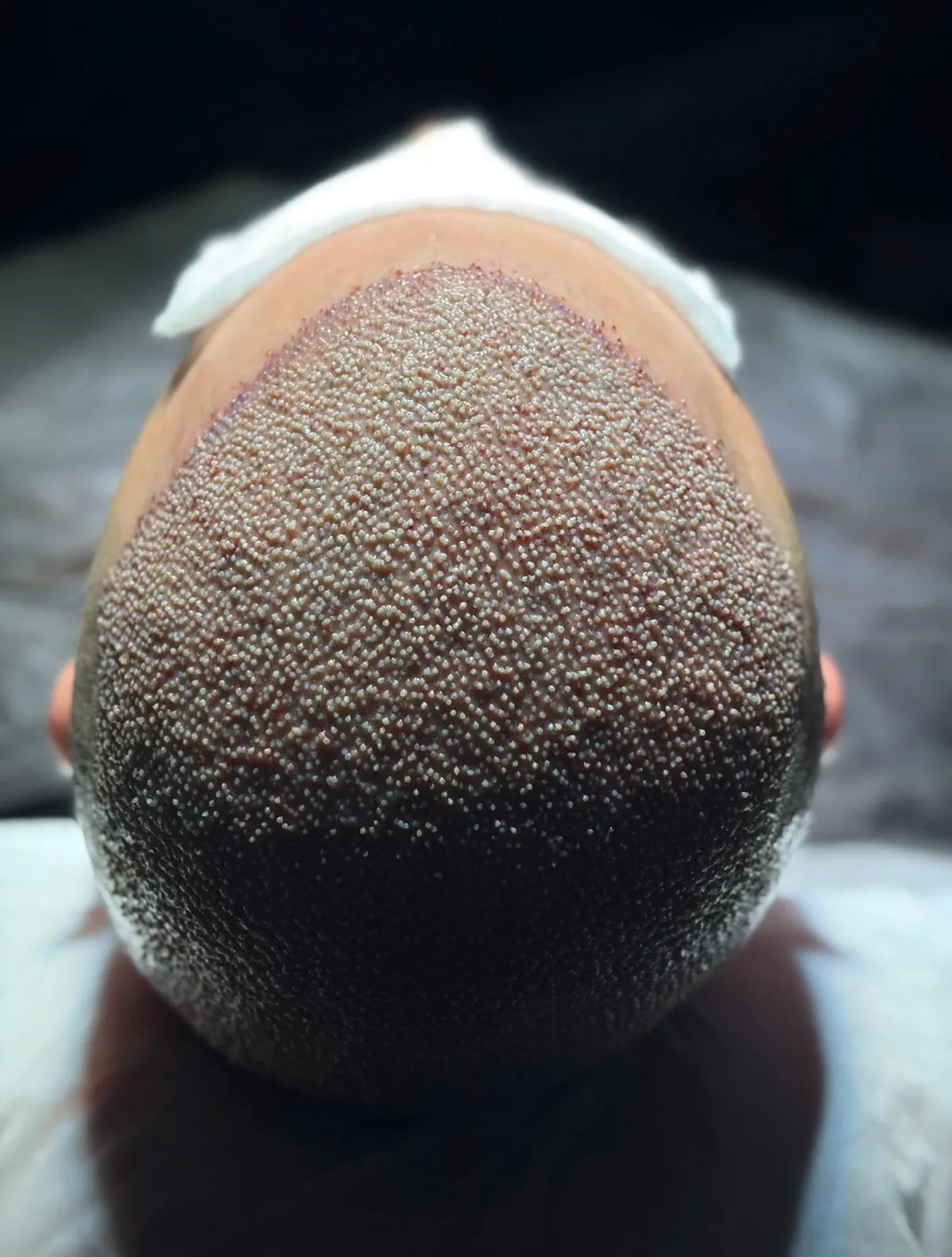
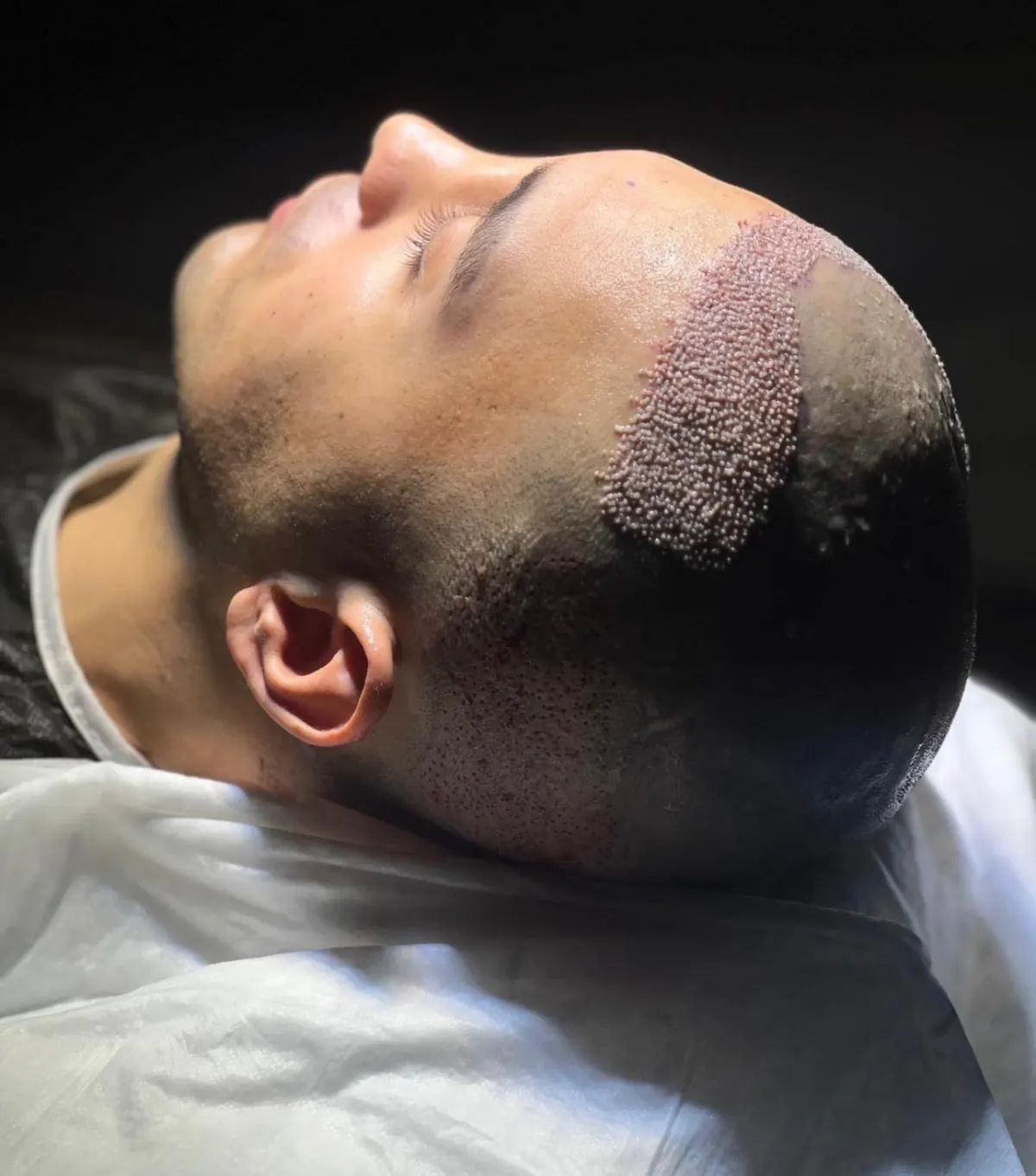
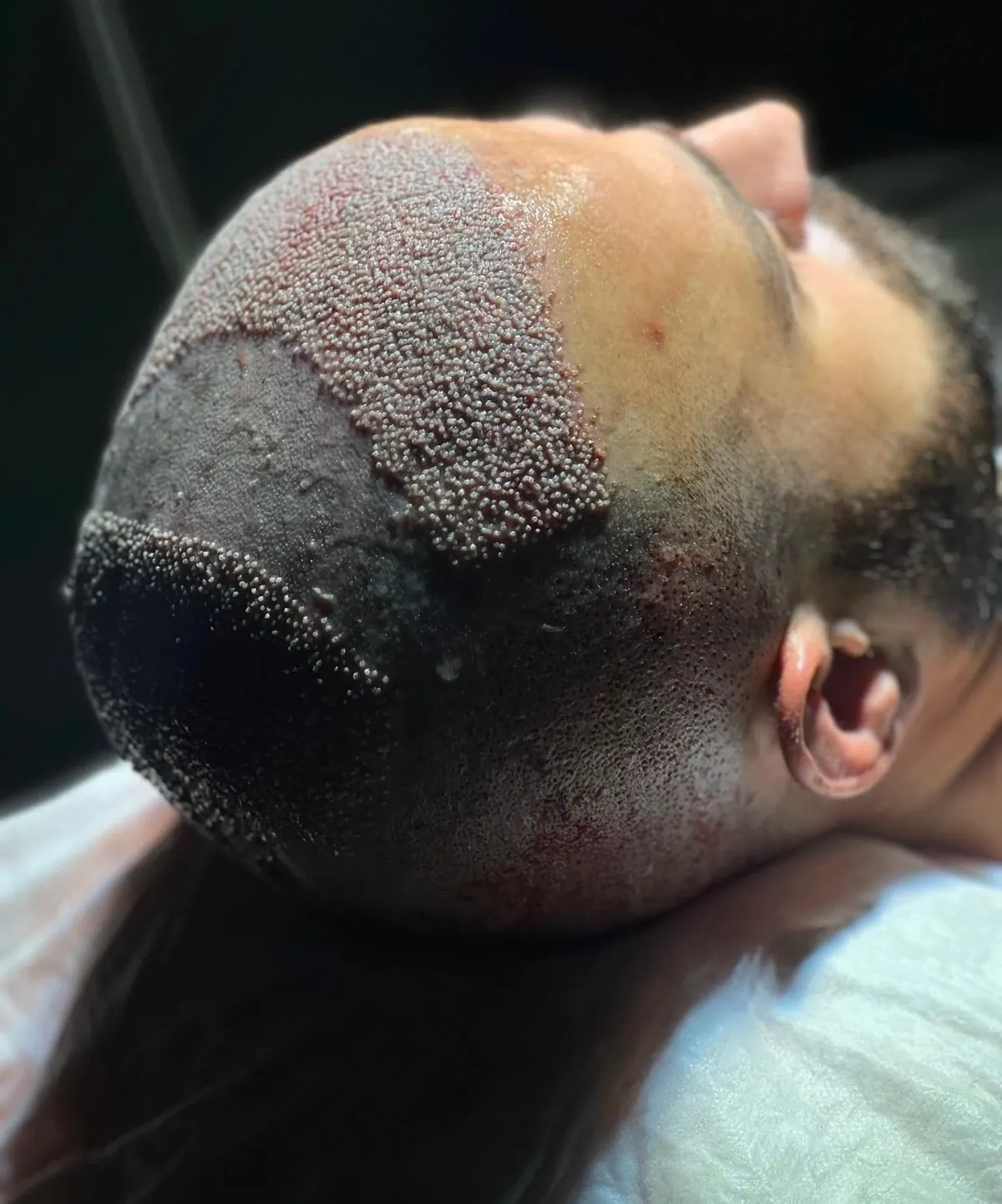
The second half of the operation is the same idea for both. The grafts are placed into channels in the thinning area, for example with fine sapphire blades in a sapphire FUE hair transplant, or with a DHI implanter pen.
What FUT (strip) hair transplant is
FUT stands for follicular unit transplantation. It is also called strip surgery or FUSS. Under local anaesthesia, the surgeon removes a long, thin strip of skin from the back of the scalp, where the hair is densest. The wound is closed with stitches, and the hair above falls over the line.
The team then divides the strip under microscopes into follicular units. A follicular unit is a natural group of one to four hairs. These grafts are placed in the recipient area in the same way as FUE grafts.
- No large shaved area: the back of the head usually does not need to be shaved, so the stitch line is hidden by your own hair.
- Linear scar: FUT always leaves a thin line scar. How fine it heals varies from person to person.
- Stitches: non-dissolving stitches are often removed around days 8–10. Some surgeons leave them in for up to 3 weeks.
What FUE hair transplant is
FUE originally stood for follicular unit extraction. In 2018 the International Society of Hair Restoration Surgery (ISHRS) changed the name to follicular unit excision. The aim was to make clear that FUE is a surgical procedure that creates open wounds, so it should be planned and performed by a doctor.
In most FUE operations the donor area is shaved short. The surgeon uses a micro punch to cut around each follicular unit (the ISHRS describes punch sizes from 0.7 to 1.2 mm), and the graft is lifted out. The small round wounds close on their own without stitches. Grafts are taken in a spread-out pattern across the donor area, so the remaining hair still looks even.
- Dot scars: FUE leaves many small dot scars that are usually hidden by short hair. FUE is not scarless.
- Short haircuts: most patients can wear their hair short once healed. A very close shave may still show the dots.
- Surgeon skill: the follicle sits below the skin at an angle, so careful control of punch angle and depth is needed to avoid cutting it (transection).
FUE vs FUT comparison table
| Factor | FUE | FUT |
|---|---|---|
| How grafts are taken | One by one with a small punch | A strip of scalp, then divided under microscopes |
| Donor scar | Many small dot scars | One thin linear scar |
| Shaving | Donor area usually shaved | Usually no shaving of the donor area |
| Hair length to hide the scar | Short haircuts usually fine | At least 2–3 cm at the back, for life |
| Stitches | None | Yes, unless dissolving stitches are used |
| Early donor discomfort | Usually mild | Tightness and soreness along the stitch line |
| Lifetime graft supply | Limited by spacing between extractions | Often more grafts over a lifetime |
| Growth of transplanted hair | Same timeline | Same timeline |
Scarring: FUE dot scars vs FUT linear scar
Every hair transplant leaves some scarring in the donor area. The real question is which type fits your life.
The FUT scar is a single line across the back of the head. The NHS notes that it should not be visible unless you have very short hair. ISHRS guidelines say patients typically need to keep their hair at least 2–3 cm long throughout their life. If you like a skin fade or a buzz cut, this is the main drawback. Some patients also notice temporary numbness above the scar.
FUE scars are tiny white dots spread across the donor area. With a normal short haircut they are usually hard to see. If too many grafts are taken from one spot, the donor area can look thin or patchy. That is why the number of grafts taken in one session matters as much as the method itself.
Be careful with any clinic that promises no scar at all. Both methods leave marks; the difference is their shape and where they show.
Recovery after FUE and FUT
The recipient area heals in the same way after both methods. Small scabs usually fall off within 10–14 days. Shock loss, when the transplanted hairs shed, usually happens between 2 and 8 weeks. New hair starts at around 3–4 months, and the final result is seen at around 12 months. Read the full hair transplant recovery timeline for the day-by-day details.
The donor area is where the two methods differ. ISHRS describes a faster recovery after FUE, and many patients report less pain after FUE than after FUT. The small FUE wounds usually close within days, and most people return to desk work in 3–5 days. After FUT, the stitch line can feel tight and sore in the first week, and you need to avoid movements that stretch the wound. Your surgeon will tell you when you can return to the gym.
With either method, contact your doctor if you have fever, spreading redness, pus, severe pain or bleeding that does not stop.
Graft numbers and the donor area
The donor area is limited. Most people have roughly 4,000–6,000 grafts available over a lifetime, and that supply also has to cover any future hair loss. Our guide on how many grafts you may need shows typical ranges by hair loss stage.
ISHRS guidelines state that, over most patients' lives, more grafts can be obtained with FUT than with FUE. A strip takes hair from the densest central band of the donor area. FUE has to leave enough space between extractions so the area does not look see-through. For patients with very advanced loss, some surgeons combine both: a strip first, then FUE in a later session.
For many patients with early to moderate hair loss, FUE can supply enough grafts. What matters most is that the surgeon takes grafts evenly and keeps a reserve for the future.
Who FUT may suit and who FUE may suit
FUT may suit you if
- You always wear your hair at least 2–3 cm long at the back.
- You do not want to shave the back of your head. Many women prefer this; see our page on female hair transplant.
- Your safe donor zone is narrow but your scalp is elastic.
- You expect to need a very high number of grafts over your lifetime and accept a linear scar.
FUE may suit you if
- You like short haircuts or fades.
- You want to avoid stitches and a linear scar.
- Your scalp is tight, or you already have a strip scar and need more grafts.
- You may need beard or body hair as an extra donor source, which only FUE can harvest.
If you prefer FUE but do not want to shave, an unshaven hair transplant can be an option for smaller graft numbers.
FUE or FUT when you travel to Istanbul
If you fly to Istanbul for a hair transplant, the donor method also shapes your trip. After FUE there are no stitches to remove, so most patients fly home a few days after surgery. After FUT, non-dissolving stitches often come out around days 8–10, and some surgeons leave them in longer. That means a longer stay, a return visit, or stitch removal by a doctor at home.
Dr. Harun Alakaya works with FUE-based techniques: sapphire FUE and DHI. Both use FUE in the donor area and differ only in how the grafts are placed. Our comparison of sapphire FUE vs DHI explains that second step. If your examination suggests that strip surgery would serve you better, for example because you need a very large lifetime supply and always wear long hair, you should hear that clearly and discuss it with a surgeon who performs FUT.
Questions to ask before choosing FUE or FUT
- How many grafts do I need now, and how many might I need in 10–15 years?
- How many grafts can my donor area safely give with each method?
- What will my donor area look like with my usual haircut?
- Who removes the grafts, and who places them?
- If I need a second procedure, how does this choice affect it?
The crown is a common reason for a second session, as it often thins after the front has been treated. Read about crown hair transplant planning if the back of your head is thinning too.
For a personal opinion, you can send photos for a free analysis. Dr. Alakaya plans each case himself and will explain which approach fits your donor area and goals.
Frequently asked questions
Is FUE better than FUT?
Neither method is better for everyone. FUE avoids a linear scar and suits short haircuts, while FUT can give more grafts over a lifetime without shaving the donor area.
Is FUT more painful than FUE?
Both are done under local anaesthesia. Afterwards, many patients report more pain and tightness after FUT because of the stitch line, while FUE donor discomfort is usually mild.
Can FUE be used to hide an old FUT scar?
Often, yes. A surgeon can place FUE grafts into a healed strip scar to make it less visible, and FUE can also harvest more grafts from around the scar. Results depend on how wide and firm the scar is.
Do FUE and FUT grafts grow at the same speed?
Yes. Transplanted hair follows the same cycle with both methods: shedding at 2–8 weeks, first growth at 3–4 months and a final result at around 12 months.
Is FUT still performed today?
Yes. ISHRS still describes both FUE and FUT as current standard practice, and some surgeons prefer FUT for selected patients who wear their hair long.
Sources
- ISHRS – Clinical Practice Guidelines for Follicular Unit Transplantation (FUT), 2024 (PDF)
- ISHRS – Guide to FUE Hair Transplant: Benefits, Process & Recovery
- ISHRS – Popular Hair Restoration Technique Updates Name to Reflect Surgical Nature of Procedure
- NHS – Hair transplant
- American Academy of Dermatology – A hair transplant can give you permanent, natural-looking results

Our articles explain hair transplant topics in plain language. They are general information and do not replace a consultation with a doctor.
About the doctor